
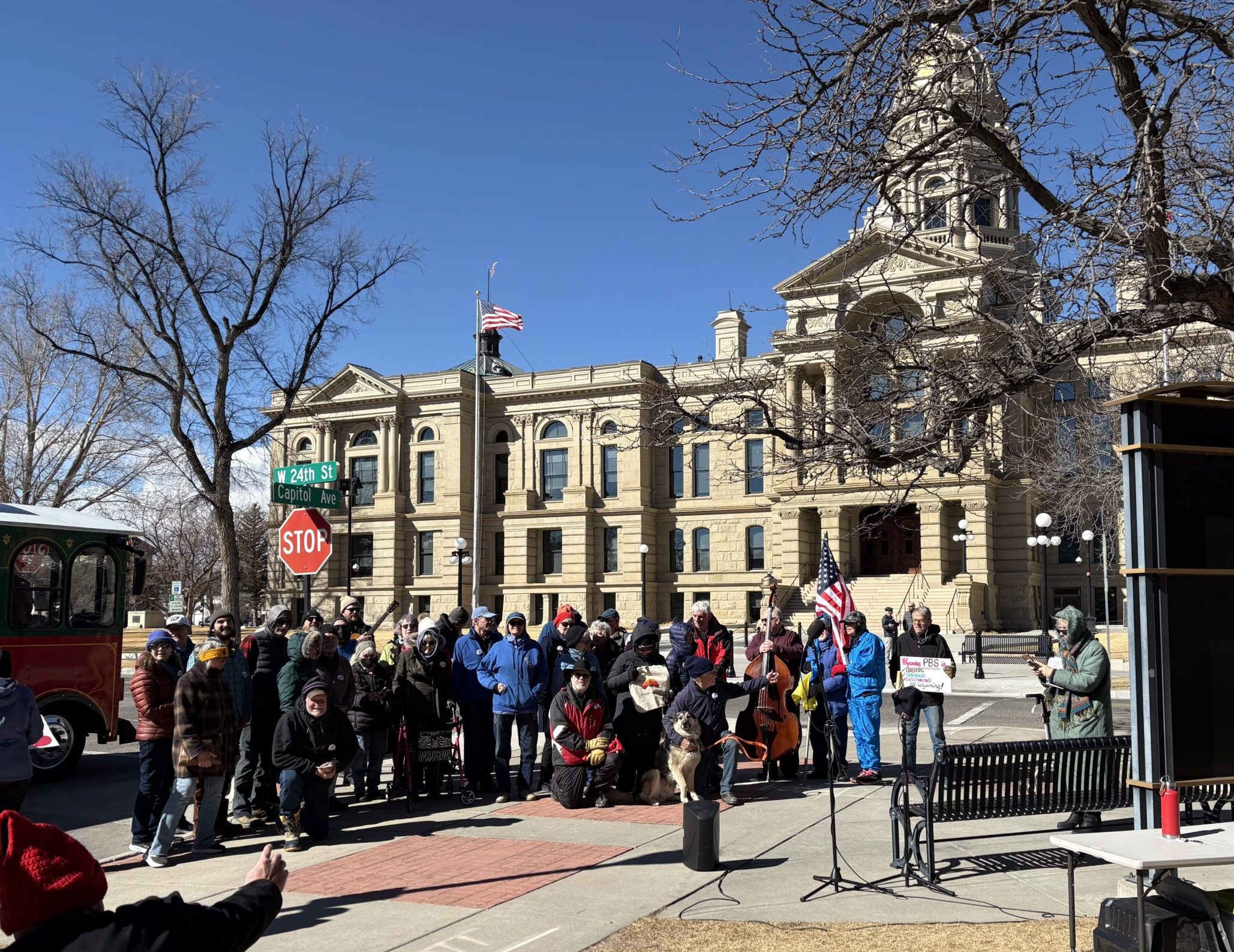
A crowd of supporters gather near the Wyoming state capitol building on February 17, 2026 to celebrate Wyoming Public Media's 60 years of serving the state.
Photo by Richard Garrett
UPDATE: The Wyoming state legislature passed a budget on March 2, 2026, that included Wyoming Public Media’s full appropriation of $1.7 million. This came after several weeks of amendments in the House and Senate of the Wyoming legislature, in addition to negotiations between the two chambers. Lawmakers heard from numerous Wyoming residents calling on the legislature to restore funding for Wyoming Public Media, underscoring the depth of support for the organization and its services throughout the state.
The statewide broadcaster faces additional state funding cuts that threaten not just programming but public safety infrastructure rural communities depend on.
In Wyoming, where winter storms close interstate highways with little warning, public safety relies on the delivery of timely, critical information. The proposed elimination of state funding to Wyoming Public Media fundamentally challenges how rural communities in the state will stay informed, connected, and most importantly, safe.
The station faces an existential threat: after weathering the rescission of federal Corporation for Public Broadcasting funds in July 2025 that cost the station $400,000 annually, Wyoming’s Joint Appropriations Committee voted in January 2026 to cut just over $800,000 annually in state support as part of a larger cut to the University of Wyoming. For an organization broadcasting to more than 90% of the state and operating on roughly $4.2 million, the combined cuts would create a $1.2 million deficit within three years.
Roles that affect the critical efforts to provide the community with public safety communications could be hit hardest by the shortfall. “These functions are managed by engineering and programming,” says Christina Kuzmych, General Manager of Wyoming Public Media since 2011. “Two engineering positions are in these cuts, and the programming production person is in these cuts, as is the traffic person. So these are the four functions that kind of overlook the emergency alerting system.”

Wyoming Public Media is a full participant in Wyoming’s Emergency Alert System. Between its four broadcast signals that reach 95% of the state’s population, the station is a key partner in elevating emergency notices to even the most rural corners of Wyoming. But the station also provides what Kuzmych calls “the softer side of emergencies” — real-time updates on the changing situation on the ground, from high winds causing issues with the snow to road closures along their main highways that affect the important trucking industry in the state.
Even during their major non-news shows like Wyoming Sounds, a local music program, hosts interrupt programming to announce conditions. In Wyoming, Kuzmych notes, “plans are very fluid.” Hosts can switch in a minute to live coverage of unfolding emergencies.
The proposed cuts threaten Wyoming Public Media’s ability to be a robust partner to local authorities. “It’s going to make our emergency alerting […] much sloppier,” Kuzmych says. “We’re not going to get to the message as quickly if we don’t have a program producer or an operations person, and both of those are on the cutting block.”
Wyoming Public Media is one of a suite of programs and institutions under scrutiny this budget session. Wyoming’s Joint Appropriations Committee pursued sweeping cuts across the University of Wyoming, the state’s only four-year university. The committee also passed a cut to the Wyoming Business Council, which supports local small business initiatives. However, the legislature is far from united behind the cuts. The Senate restored with bipartisan support all funding to the University of Wyoming, including funding for Wyoming Public Media, in its own budget proposal.
Lawmakers have also been hearing from constituents who oppose the cuts to services that make Wyoming a better place to live. In an article about the Senate’s decision to restore funding for the University published by WyoFile, Senate Majority Floor Leader Tara Nethercott said the budget amendment reflected the will of the constituents.
“The people of Wyoming have spoken. And they have said, ‘fund our future,’” Sen. Nethercott, a Republican from Cheyenne, said.
On February 17, 2026, supporters of Wyoming Public Media gathered near the Wyoming State Capitol to celebrate 60 years of Wyoming Public Media and beyond. Even amid a windy advisory that brought strong wind gusts across the capitol grounds, about 60 supporters gathered to commemorate the station’s decades of services.
Rep. Elissa Campbell (R-Casper) spoke about the value of Wyoming Public Media to the people of Wyoming. Rep. Karlee Provenza (D-Laramie) and Rep. Trey Sherwood (D-Laramie), who both represent the town where the station is based, also spoke. Kevin Reddy, president of the Federated Fire Fighters of Wyoming underscored the station’s role in public safety systems. According to coverage of the event from the Wyoming Tribune Eagle, Reddy said evacuation notices and emergency alerts are “some of the biggest services” emergency services rely on.
Governor Gordon has also pushed back against cuts. He argued Wyoming faces no fiscal crisis that justified reductions and criticized the speed of the cuts at a Lander town hall.
The $1.69 million two-year appropriation to Wyoming Public Media through the university’s block grant is particularly important when considering Wyoming’s unique geographic and population challenges. Wyoming’s 580,000 residents create too small a donor base to absorb such deep losses. After federal cuts, supporters raised nearly $800,000 to cover the loss. But can donors really be expected to sustain more? Particularly considering their tax dollars were already supposed to support these services. “How are they feeling now that there’s a quadruple cut coming? Will they be there?” wonders Kuzmych.
If state cuts proceed, the station would likely have to cut its news department from ten to five. “We would have to reduce our two state government reporters who are both in Cheyenne right now with microphones under people’s noses,” Kuzmych says. For a state where reporters already work virtually due to distances, losing in-person coverage would diminish legislative accountability.
“We always state that we want to go for the story, we go for all sides, and we present all sides and we don’t have an opinion,” Kuzmych explains. “It’s up to the audience to figure out how they want to think about an issue.”
Wyoming Public Media’s fate remains uncertain, but Wyomingites are rallying around the station in support. “We’ve been pushing this since January 13th on air and providing information for how to reach our legislators,” says Kuzmych, hoping their audience outreach is connecting with lawmakers.
For rural stations nationwide, stakes extend beyond Wyoming. The first-ever Rural Voices Day on March 4, 2026, celebrates resilience while underscoring vulnerability. When distances are vast and emergencies frequent, rural public radio becomes essential infrastructure.
Whether lawmakers recognize this enough to restore funding will determine not just one station’s survival but establish precedent for how rural communities navigate fiscal austerity versus essential services. For now, Kuzmych and her staff prepare for multiple scenarios while maintaining the daily work of keeping Wyoming informed, connected, and — when storms close highways and fires threaten ranches — safe.
Other Stories
See All
August 6, 2026
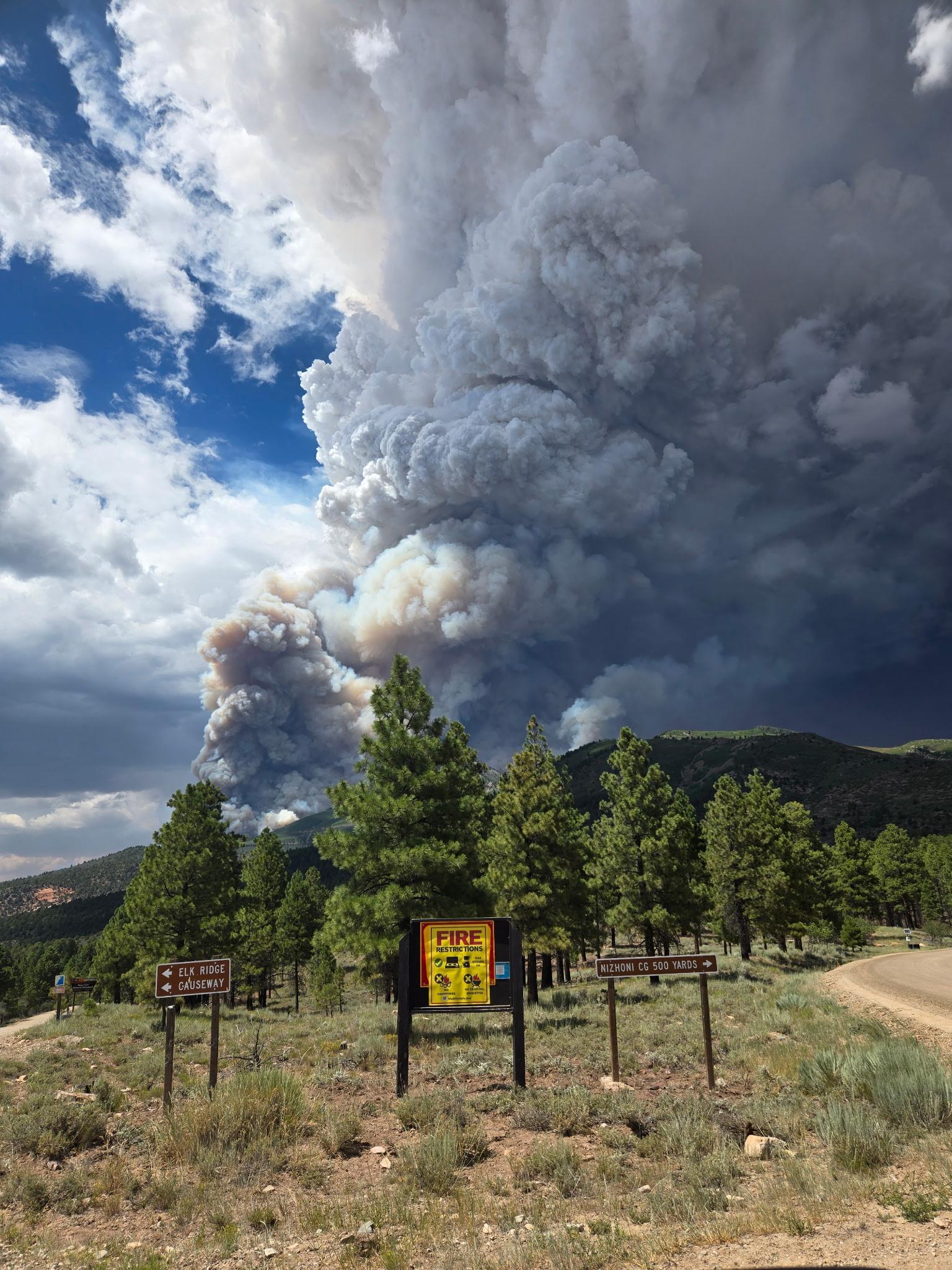
Through the West’s Worst Fire Season in Years, Local Public Media Keeps their Communities Informed
June 16, 2026
On Capitol Hill, Rural Station Leaders and the Lawmakers Who Represent Them Emphasize Their Vital Service

April 30, 2026
For Native Public Media and Tribal Radio Stations, the Signal Must Stay On

April 3, 2026
For Visually-Impaired Kansans in Rural Areas, Audio-Reader Brings the Local Stories

March 6, 2026
The First-Ever Rural Voices Day
